7 Best Generative AI Courses for Nurses in 2026: Skills for Real Clinical Work
By Samuel G · · 11 min read
Beginners who want a broad, no-code introduction to generative AI should start with Generative AI for Everyone by DeepLearning.AI. Nurses who want a free, career-focused overview can take the University of Maryland certificate. Those who want a personalised path built around their own documentation or patient education goals can use Upskili. Nurses seeking a formal certificate or deeper technical skills should consider Johns Hopkins, Udacity, Microsoft Learn, or Google Cloud depending on their role.
Quick comparison
| Course | Provider | Best for | Level | Duration | Certificate | Cost |
|---|---|---|---|---|---|---|
| Generative AI for Everyone | DeepLearning.AI | Beginners wanting a no-code overview | Beginner | 5h1m | Earn a certificate with PRO | Check the provider's current pricing. |
| Personalised learning path | Upskili (publisher of this guide) | Nurses with a specific goal to practise on their own tasks | Not stated | Not stated | Not stated | Free to approximately $20, depending on AI token/credit usage |
| Free Online Certificate in Artificial Intelligence and Career Empowerment | Robert H. Smith School of Business, University of Maryland | Early to mid-career nurses wanting a free overview | Not stated | Not stated | Free certificate | Free |
| Explore the business value of generative AI solutions | Microsoft Learn | Nurse leaders and informaticists | Not stated | Not stated | Not stated | Check the provider's current pricing. |
| Applied Generative AI and Agentic AI | Johns Hopkins University | Nurses wanting a university certificate and hands-on projects | Not stated | 16 Weeks Online | Certificate of Completion; 11 CEUs | Check the provider's current pricing. |
| Applied Generative AI Engineering | Udacity | Nurses moving into technical or informatics roles | Intermediate | 56 hours | Program Certificates | Subscription · Monthly |
| Advanced: Generative AI for Developers | Google Cloud (Google Skills) | Nurses with a developer background | Advanced | Not stated | Not stated | Check the provider's current pricing. |
How we chose these courses
These seven courses were selected because they address the real tasks nurses handle every week: writing care plans, drafting patient education materials, synthesising evidence, and coordinating care. We looked for courses that did not assume a prior coding background while also including options for those who want technical depth. Every course on this list meets at least three of these criteria:
- Relevance to nursing tasks: The content covers skills applicable to documentation, patient communication, evidence synthesis, or care coordination, not just generic AI theory.
- No unnecessary prerequisites: Entry-level options are included so nurses without a technical background can start immediately.
- Hands-on practice: Preference was given to courses that include applied projects or exercises where you work with real-world scenarios.
- Clear cost: Free and paid options are labelled so you can plan without surprises.
- Recognised certificate where it matters: Certificates from universities or major providers are noted for nurses who need evidence of professional development.
The list is ordered from the most accessible starting point to the most specialised. Course details come from each provider's own page, checked on the dates given in their records. We did not take the courses ourselves.
The 7 best generative AI courses for nurses, one by one
1. Generative AI for Everyone (DeepLearning.AI)
Best for: Nurses who are new to generative AI and want a clear, no-code introduction from a respected instructor.
This is a beginner course taught by Andrew Ng that explains how generative AI works, what it can do, and its impact on business and society. It requires no coding or prior AI knowledge, making it the most accessible entry point for a staff nurse or nurse manager who simply wants to understand the technology before using it.
What you'll learn:
- How generative AI works and what it can realistically do
- Common tools and their real-world applications
- The broader impact of generative AI on business and society
- How to think critically about AI use cases
Worth knowing: This course gives you a conceptual foundation. It does not walk you through drafting a nursing note or a patient handout. You will need to apply the principles to your own clinical context afterwards.
Cost and certificate: Check the provider's current pricing. A certificate is available with a PRO subscription.
2. Upskili: a personalised path for your goal
Best for: Nurses who have a specific task they want to improve, such as reducing the time spent on shift handover documentation or creating clearer discharge instructions.
Upskili, the platform that publishes this guide, does not offer a fixed, pre-written course. You state what you want to achieve at work, and it builds a personalised, AI-powered learning path around that goal, adapting as you learn. It is especially relevant if you want learning that starts from your own nursing context rather than a generic syllabus.
Here is the path Upskili generated for the goal "use AI to reduce documentation time and improve patient education":
AI for Faster Documentation and Better Patient Education Use AI tools to draft clinical notes and create clear patient education materials in a fraction of the time, while keeping accuracy and privacy intact.
1. Put AI to Work on Your Documentation and Patient Handouts
- See where AI fits in your workflow
- Write prompts that get usable drafts
- Draft a clinical note from bullet points
What you'll learn:
- Identifying where AI fits into your specific nursing workflow
- Writing prompts that produce usable clinical drafts
- Drafting a clinical note from bullet points
- Reviewing and finalising AI-generated content for accuracy
Worth knowing: Every learner's path differs based on their stated goal, background, and progress. The example above is illustrative, not a fixed curriculum. You need to be comfortable learning by doing with your own real-world tasks.
Cost and certificate: Free to approximately $20, depending on AI token/credit usage. Certificate not stated.
3. Free Online Certificate in Artificial Intelligence and Career Empowerment (Robert H. Smith School of Business, University of Maryland)
Best for: Early to mid-career nurses who want a free, recognised certificate and a broad view of how AI changes professional work.
This free online programme covers an overview of artificial intelligence, how it transforms business functions, and career-focused topics such as job searching and consulting. For a nurse considering a move into management, quality improvement, or an educator role, the career empowerment module adds practical value beyond the AI content itself.
What you'll learn:
- An overview of artificial intelligence as a technology
- How AI is transforming different functional areas of a business
- Career empowerment strategies, including job searching and consulting skills
Worth knowing: The content is designed for a general professional audience, not healthcare specifically. You will need to translate the business-function examples into a clinical context yourself.
Cost and certificate: Free. A free certificate in "Artificial Intelligence and Career Empowerment" is awarded by the Robert H. Smith School of Business at the University of Maryland.
4. Explore the business value of generative AI solutions (Microsoft Learn)
Best for: Nurse leaders, clinical informaticists, and nurses involved in service improvement who need to evaluate and make a case for AI tools.
This learning path from Microsoft is built for business leaders. It covers identifying high-value generative AI opportunities, assessing organisational readiness, and implementing responsible AI solutions. For a nurse manager preparing a proposal for an AI documentation pilot on their ward, the readiness and implementation modules are directly useful.
What you'll learn:
- Generative AI concepts relevant to business decisions
- Identifying high-value opportunities for generative AI in your organisation
- Assessing readiness for AI adoption
- Implementing responsible AI solutions, including an introduction to Microsoft Copilot and Azure AI
Worth knowing: The course frames AI value through a business lens. It will not teach you to write a better nursing prompt, but it will help you build the argument for why your unit should adopt a tool.
Cost and certificate: Check the provider's current pricing. Certificate not stated.
5. Applied Generative AI and Agentic AI (Johns Hopkins University)
Best for: Nurses who want a formal university certificate and are prepared for a substantial, 16-week commitment with hands-on projects.
This online certificate programme comes from a university with deep healthcare credibility. It covers large language models, retrieval-augmented generation, prompt engineering, fine-tuning, agentic workflows, and responsible AI. The hands-on projects give you concrete experience, and the 11 continuing education units are a measurable professional development record.
What you'll learn:
- How large language models and generative AI work
- Prompt engineering and retrieval-augmented generation (RAG)
- Fine-tuning models for specific tasks
- Building agentic workflows
- Responsible AI principles and practice
Worth knowing: It is designed for technology and data professionals. A nurse without some comfort with technical concepts may find the pace demanding. The 16-week structure requires consistent weekly time.
Cost and certificate: Check the provider's current pricing. A Certificate of Completion from Johns Hopkins University and 11 CEUs are awarded.
6. Applied Generative AI Engineering (Udacity)
Best for: Nurses with some technical background who want to build and deploy AI solutions, perhaps moving into a clinical informatics or health-tech role.
This intermediate nanodegree programme focuses on building and deploying generative AI solutions. It covers model selection, prompt engineering, parameter-efficient fine-tuning, RAG systems, vector databases, and multimodal applications. For a nurse already comfortable with healthcare data who wants to prototype a tool for their department, this is the most practical technical option.
What you'll learn:
- Selecting and applying generative AI models
- Advanced prompt engineering techniques
- Parameter-efficient fine-tuning (PEFT)
- Building retrieval-augmented generation systems with vector databases
- Working with multimodal AI applications
Worth knowing: This is a developer-focused programme. You are expected to have programming experience. It is not suitable as a first AI course.
Cost and certificate: Subscription, billed monthly. Program Certificates are awarded on completion.
7. Advanced: Generative AI for Developers (Google Cloud)
Best for: Nurses who are also experienced developers, or clinical informaticists working directly with Google Cloud infrastructure.
This is a technical learning path with 12 activities, built for app developers, machine learning engineers, and data scientists. Google recommends completing their Introduction to Generative AI learning path first. For the small number of nurses who write code for clinical applications, this provides deep, platform-specific technical skill.
What you'll learn:
- Advanced generative AI development techniques on Google Cloud
- A sequence of 12 technical activities building applied skills
Worth knowing: This is the most technically demanding option on the list and is not designed for a clinical audience. A nurse without a developer background should start elsewhere.
Cost and certificate: Check the provider's current pricing. Certificate not stated.
Which course should you start with?
Your choice depends on your current comfort with technology and what you need the skill for.
- New to generative AI: Start with Generative AI for Everyone (entry 1). It is short, requires no coding, and gives you a solid mental model of what the technology can and cannot do.
- Short on time and want a free overview: The University of Maryland certificate (entry 3) is free, comes from a recognised business school, and includes career-focused content.
- Need a certificate for your CV or revalidation: Consider the Johns Hopkins programme (entry 5) for a university credential with CEUs, or the Udacity nanodegree (entry 6) for a technical certificate.
- Want to practise on your own nursing tasks immediately: Upskili (entry 2) starts from your specific goal and builds a path around it. You learn by working on the documentation or patient education tasks you already do.
- In a leadership, informatics, or business-case role: Microsoft Learn (entry 4) helps you evaluate opportunities and build an adoption case. Google Cloud (entry 7) suits the few nurses working as developers.
A learning path for nurses
A phased approach works best for building generative AI skills you will actually use on the ward or in the clinic.
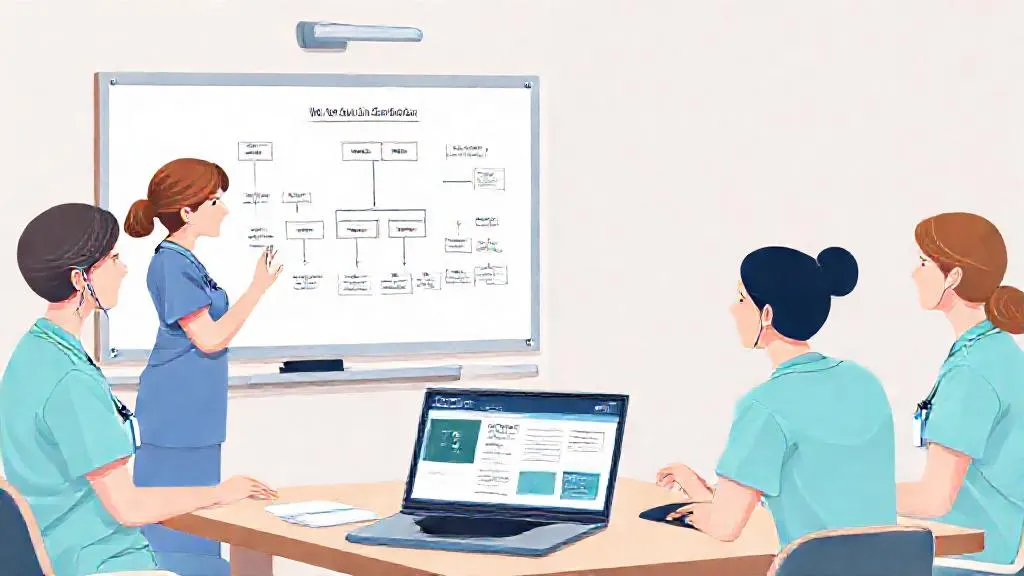
- Foundations: Begin with Generative AI for Everyone (entry 1) to understand the technology without technical overhead. If time is tight, the free University of Maryland certificate (entry 3) also provides a solid overview.
- Hands-on practice with your own tasks: Once you understand the basics, apply them. Use Upskili (entry 2) to build a personalised path around a specific goal, such as drafting shift summaries or creating plain-language medication instructions. This is where the skill becomes useful, not just theoretical.
- Specialisation: Depending on your role, choose a deeper option. The Johns Hopkins certificate (entry 5) offers a university credential and structured projects. Microsoft Learn (entry 4) suits nurses making a leadership case for AI adoption. Udacity (entry 6) and Google Cloud (entry 7) are for those moving into technical or developer roles.
Where generative AI fits in nursing work
Generative AI is not a clinical decision-maker. It is a drafting and summarising tool that must be reviewed by a qualified nurse. AI output cannot replace nursing judgement, professional standards, or the nurse's signature on a record. Here is where it can help.

Documentation and handover. A nurse can use AI to draft a shift handover summary from bullet points or to structure a care plan entry. For example, a staff nurse types "admitted with COPD exacerbation, IV antibiotics started, oxygen weaned to 2L, awaiting physio review" and asks the tool to expand it into a structured ISBAR handover paragraph. The nurse then checks every detail, corrects any errors, and signs the entry.
Patient education. AI can generate a plain-language explanation of a procedure or medication. A practice nurse might ask for "a simple, one-page handout on warfarin for a patient with low health literacy, explaining when to take it, what foods to avoid, and when to call the clinic." The draft is then checked against current guidelines and the patient's own care plan before it is shared.
Evidence and policy synthesis. A nurse educator preparing an in-service session can ask AI to summarise a new clinical guideline into key practice changes. The output is a starting point. Every point must be verified against the original source document and local policies before it is presented to colleagues.
Care coordination. Drafting a referral letter or a message to a multidisciplinary team member can start with AI. A community nurse might prompt, "Draft a referral to dietetics for a 72-year-old patient with unintentional weight loss, recent discharge after hip surgery, living alone." All clinical details must be confirmed, and the final message must be approved before sending.
How to decide where to start
Pick one course and start. A five-hour beginner course finished this week is worth more than a 16-week certificate you never begin. If you are new to AI, Generative AI for Everyone (entry 1) is the most straightforward on-ramp. If you learn best by doing your own work, try a personalised path built around your nursing goal with Upskili (entry 2). If you need a credential for a promotion or a move into informatics, commit to the Johns Hopkins certificate (entry 5). Choose the option that matches where you are now, not where you think you should be.
Frequently asked questions
Will AI replace nurses?
No. AI can assist with documentation, patient education drafting, and information synthesis, but nursing requires clinical judgement, physical assessment, empathy, and human connection that AI cannot replicate. The technology is a tool to reduce administrative burden, not a replacement for the nurse at the bedside.
Do I need coding experience to use generative AI as a nurse?
Not for the everyday tasks nurses are likely to use AI for. Writing a prompt to draft discharge instructions or summarise a policy document requires no coding. Several courses on this list, including the DeepLearning.AI and University of Maryland options, are designed for complete beginners. More technical courses exist if you want to understand how the models work.
Can I use AI to write my nursing notes?
You can use AI to draft notes from bullet points or a verbal summary, but you must review every word for accuracy before signing. The nurse remains fully responsible for the content of the clinical record. Never input identifiable patient data into a general-purpose AI tool unless your organisation has approved it and a data processing agreement is in place.
Is a free certificate worth anything for my nursing career?
A free certificate from a recognised institution like the University of Maryland's Robert H. Smith School of Business can demonstrate continuing professional development and interest in AI. It may not carry the same weight as a paid, in-depth programme, but it is a credible addition to a CV, especially for nurses moving into leadership, informatics, or quality improvement roles.
How do I keep patient data safe when using AI tools?
This is a critical concern. Do not enter any protected health information into a public AI tool unless your employer has a specific, approved instance with a business associate agreement in place. For learning purposes, use de-identified or fictional examples. Your organisation's privacy officer and AI governance policy should guide which tools are safe to use with real patient data.
Which course is best if I want to move into nursing informatics?
Start with a foundation in what generative AI can do for healthcare, using the DeepLearning.AI or Microsoft Learn course. Then consider the Johns Hopkins Applied Generative AI and Agentic AI certificate for a formal credential, or the Udacity nanodegree if you want hands-on technical skills in building and deploying AI systems.
How much time do I need to commit to learn useful AI skills?
You can gain a practical working understanding in under six hours with a course like Generative AI for Everyone. A deeper, project-based certificate like Johns Hopkins takes 16 weeks part-time. The most important factor is practising with real nursing tasks. A personalised path that focuses on your specific goal can make the time you spend directly relevant.
Turn this into a plan for you
Tell Upskili what you want to be able to do. It works out the skills involved, starts from what you already know, and teaches them in order, adjusting as you go.
Start with your goalSources
- Generative AI for Everyone, DeepLearning.AI
- Free Online Certificate in Artificial Intelligence and Career Empowerment, Robert H. Smith School of Business, University of Maryland
- Explore the business value of generative AI solutions, Microsoft Learn
- Applied Generative AI and Agentic AI, Johns Hopkins University
- Applied Generative AI Engineering, Udacity