7 Best AI Courses for Nurses in 2026: Skills for Real Shifts
By Samuel G · · 10 min read
If you want to cut your charting time, write clearer discharge instructions, or get a faster second check on medication interactions, start with a course that mirrors clinical workflows. The Alison course is the quickest and free. For a certificate and hands-on projects, Google's fits a nurse's schedule. Upskili builds a path around your own goal, such as reducing documentation time.
Quick comparison
| Course | Provider | Best for | Level | Duration | Certificate | Cost |
|---|---|---|---|---|---|---|
| Artificial Intelligence for Beginners | Alison | A fast, free introduction | Beginner | 1.5-3 Hours | CPD-Accredited | Free |
| Personalised learning path | Upskili (publisher of this guide) | Learning tailored to your own nursing goal | Not stated | Not stated | Not stated | Free to approximately $20, depending on AI token/credit usage |
| Google AI Professional Certificate | Hands-on practice with workplace AI | Beginner | Self-paced online | Not stated | Check the provider's current pricing. | |
| Introduction to Artificial Intelligence (AI) | IBM | A short, structured week on core AI | Beginner | 1 week at 10 hours a week | Shareable certificate | Check the provider's current pricing. |
| Foundations of AI | IBM | A broader AI certificate under 3 months | Not stated | 3 months | Earn a certificate | Original price: $197 USD; Discounted price: $177.30 |
| IBM AI Developer Professional Certificate | IBM | Nurses who want to build AI tools | Beginner | 6 months at 4 hours a week | Shareable certificate | Check the provider's current pricing. |
| Computer Science for Artificial Intelligence | HarvardX | A deep technical foundation | Beginner | 5 months | Earn a certificate | Original price: $518 USD; Discounted price: $466.20 |
How we chose these courses
We looked for courses a working nurse can actually finish between shifts. These five criteria shaped the list.
- Relevance to nursing tasks: The course covers skills you can apply directly to clinical documentation, patient education, triage support or medication checks.
- No unnecessary prerequisites: Every course here is accessible without a coding background, except where programming is taught from scratch.
- Hands-on practice: Activities, labs or projects that let you practise on scenarios close to clinical workflows.
- Clear cost: The price is stated on the provider's page or the course is free, with no hidden fees.
- Recognised certificate where it matters: Several offer a shareable certificate or CPD accreditation that may support your continuing education.
The list runs from the most accessible starting point to the most specialised. Course details come from each provider's own page, checked on 2026-09-29. We did not take the courses ourselves.
The 7 best AI courses for nurses, one by one
1. Artificial Intelligence for Beginners (Alison)
Best for: A nurse who wants a free, no-commitment taste of what AI is before deciding whether to go deeper.
This is a short, self-paced online course that explains the basics: the history of AI, types of AI systems, machine learning classifications, and where AI is used across industries. It is the quickest way to get the vocabulary straight.
What you'll learn:
- The historical development of artificial intelligence
- Types of AI systems and how they differ
- Machine learning classifications
- Applications of AI in various industries
Worth knowing: At 1.5 to 3 hours, it covers concepts only. There are no hands-on labs with AI tools, so you will need another course to practise.
Cost and certificate: Free. CPD-Accredited certificate.
2. Upskili: a personalised path for your goal
Best for: A nurse who knows the task they want to improve, say, writing discharge summaries faster or drafting patient education handouts, and wants a path built around that goal.
Upskili, the platform that publishes this guide, does not give you a fixed curriculum. You state what you want to achieve in your nursing work. Upskili works out the skills that goal requires and teaches them in order, adapting as you learn. It measures progress by what you can demonstrate, not by hours logged.
Start with your own nursing goal
What you'll learn:
- A sequence of skills mapped to your specific goal, such as using generative AI for clinical documentation
- How to apply those skills to your own patient scenarios
- The limitations and review steps needed before any AI output enters a clinical record
Worth knowing: This is not a pre-written course with a fixed syllabus. It works best if you have a clear goal in mind. Free access depends on AI token usage, so heavier use may cost up to approximately $20.
Cost and certificate: Free to approximately $20, depending on AI token/credit usage. Certificate not stated.
3. Google AI Professional Certificate (Google)
Best for: A nurse who wants hands-on practice with generative AI applied to workplace tasks, with a portfolio to show for it.
This program teaches you to use generative AI for strategy, creativity and streamlining repetitive tasks. It includes over 20 hands-on activities and a portfolio of AI projects. The focus on everyday workplace tasks makes it a practical fit for clinical settings.
What you'll learn:
- Using generative AI for workplace strategy and planning
- Boosting creativity with AI tools
- Streamlining repetitive tasks (documentation drafts, information summaries)
- Building a portfolio of AI projects
Worth knowing: The certificate's recognition depends on your employer or regulator. Check with your nursing board if you plan to use it for continuing education credits.
Cost and certificate: Check the provider's current pricing. Certificate details not stated on the provider page.
4. Introduction to Artificial Intelligence (AI) (IBM)
Best for: A nurse who wants a structured, short course that fits into one week of annual leave or a quiet run of days off.
This course packs core AI concepts into roughly 10 hours: deep learning, machine learning, neural networks and generative AI models. It is designed for everyone, including professionals with no technical background. The shareable certificate gives you something to add to your portfolio quickly.
What you'll learn:
- Core AI concepts and terminology
- Deep learning and machine learning fundamentals
- Neural networks and how they work
- Generative AI models and their capabilities
Worth knowing: At 10 hours in one week, the pace is intense if you are on full shifts. The course covers concepts well but has less hands-on practice with actual AI tools than the Google certificate.
Cost and certificate: Check the provider's current pricing. Shareable certificate.
5. Foundations of AI (IBM)
Best for: A nurse who wants a broader, more technical AI certificate that still finishes in under three months.
This professional certificate covers AI fundamentals, machine learning, deep learning, large language models, neural networks and prompt engineering. Hands-on labs use tools like ChatGPT, Copilot and Gemini, tools you are likely to encounter in or outside clinical settings.
What you'll learn:
- AI fundamentals and machine learning
- Deep learning and large language models
- Neural networks
- Prompt engineering with ChatGPT, Copilot and Gemini
Worth knowing: The prompt engineering labs use general-purpose tools, not healthcare-specific ones. You will need to adapt the techniques to clinical documentation and patient communication yourself.
Cost and certificate: Original price $197 USD, discounted to $177.30. Earn a certificate.
6. IBM AI Developer Professional Certificate (IBM)
Best for: A nurse who wants to go beyond using AI tools and learn to build simple AI-powered applications, such as a chatbot for patient FAQs.
This is a beginner-level professional certificate that teaches software engineering, AI, generative AI, prompt engineering, HTML, JavaScript and Python. You build AI-powered chatbots and apps through hands-on labs and projects. It requires about 4 hours a week over 6 months.
What you'll learn:
- Software engineering principles
- AI and generative AI concepts
- Prompt engineering
- HTML, JavaScript and Python programming
- Building AI-powered chatbots and apps
Worth knowing: This course teaches programming, so the time commitment is real. It suits a nurse who is curious about health tech development or informatics, not someone who just wants to speed up their notes.
Cost and certificate: Check the provider's current pricing. Shareable certificate.
7. Computer Science for Artificial Intelligence (HarvardX)
Best for: A nurse considering a longer-term move into health informatics or clinical data science.
This professional certificate combines CS50's Introduction to Computer Science with CS50's Introduction to Artificial Intelligence with Python. It covers programming fundamentals, graph search algorithms, reinforcement learning, machine learning and AI principles. It takes about 5 months self-paced.
What you'll learn:
- Programming fundamentals in Python
- Graph search algorithms
- Reinforcement learning
- Machine learning principles
- Artificial intelligence principles
Worth knowing: This is the most technically demanding course on the list. It assumes no prior programming but moves fast. For a nurse still working full shifts, the 5-month estimate may stretch.
Cost and certificate: Original price $518 USD, discounted to $466.20. Earn a certificate.
Which course should you start with?
Match your situation to a course and start there. You can always add another later.

- New to AI and short on time: Start with the Alison course (entry 1). It is free and under 3 hours. You will know the landscape and can decide your next step.
- You have a specific nursing goal already: Upskili (entry 2) builds the path around that goal, whether it is faster charting, clearer patient handouts or something else.
- You want hands-on practice with workplace AI: The Google certificate (entry 3) gives you over 20 activities and a portfolio you can show.
- You need a certificate quickly: IBM's Introduction to AI (entry 4) fits into one week and gives you a shareable certificate.
- You want a broader AI foundation with a recognised certificate: IBM's Foundations of AI (entry 5) balances depth and duration at about 3 months.
- You want to build AI tools, not just use them: Start with the IBM AI Developer certificate (entry 6) or the HarvardX series (entry 7), depending on how much time you have.
A learning path for nurses
If you prefer a phased approach, here is one way to build your skills without overlapping.
Phase 1: Foundations. Take the Alison course (entry 1) or IBM's Introduction to AI (entry 4) to get the concepts and vocabulary. Pick Alison if you want minimal time and zero cost. Pick IBM if you want a certificate and can spare 10 hours in a week.
Phase 2: Hands-on practice with your own tasks. Move to the Google certificate (entry 3) or Upskili (entry 2). Google's is a fixed curriculum with a portfolio. Upskili adapts to your goal, say, drafting discharge summaries from your notes, and teaches the skills in order.
Phase 3: Specialisation (optional). If you want to build AI tools or move into informatics, choose the IBM AI Developer certificate (entry 6) or HarvardX (entry 7). IBM's is more applied; HarvardX gives you a deeper computer science foundation.
Where AI fits in a nurse's work
AI is starting to show up in four areas of daily nursing practice. In every case, the output needs your professional review. AI does not replace your judgement or sign-off.
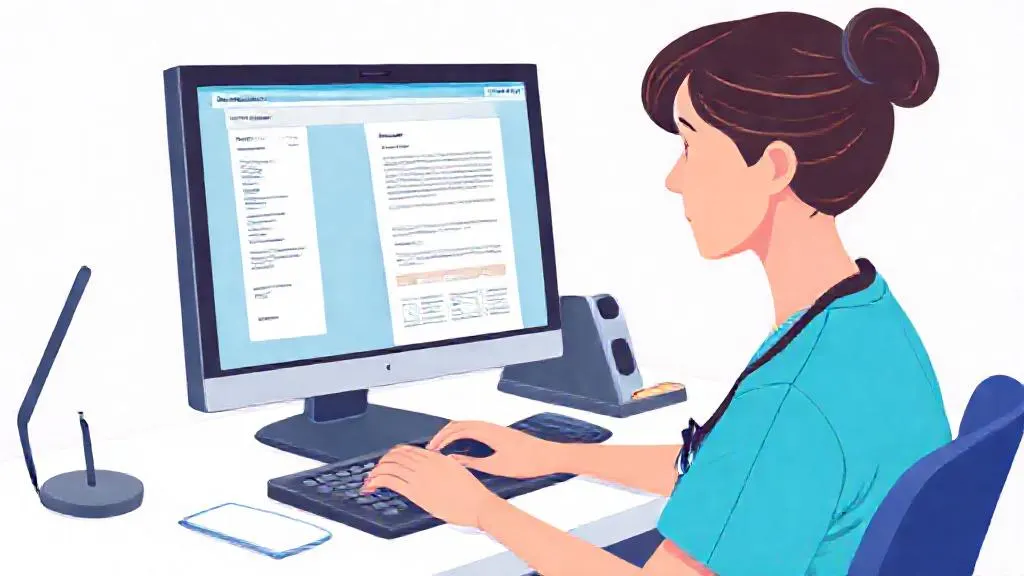
Clinical documentation. You can use AI to draft a nursing note or summarise a shift's events from your own rough input. For example, after a busy shift, you dictate a few bullet points about a patient's condition changes, and an AI tool expands them into a structured note. You review every line, correct anything inaccurate, and finalise it in the EHR yourself.
Patient education. Generative AI can turn a standard discharge instruction into plain language tailored to a patient's reading level and first language. Suppose you need to explain wound care to a patient who speaks limited English. You prompt an AI tool to rewrite the instructions at a Grade 5 reading level and then verify the clinical accuracy before handing them over.
Triage and prioritisation. Some triage systems now use AI-assisted symptom checkers to suggest urgency levels. The AI might flag a patient's reported symptoms as high risk. You use that flag as one input among many, alongside your own assessment, vital signs and experience, to decide the actual priority.
Medication reconciliation. AI tools can scan a medication list and flag potential interactions or duplicate therapies. For example, an AI tool highlights that a newly prescribed antibiotic interacts with the patient's existing anticoagulant. The alert prompts you to check with the pharmacist and confirm the order before administration. The AI flags; you and the pharmacist decide.
In all these tasks, the rule is the same: AI output is a draft or a prompt. The nurse reviews, verifies and takes responsibility for the final clinical action.
How to decide where to start
Pick the course that matches your biggest time drain. If charting eats up your end of shift, start with a course that teaches documentation drafting. If you spend too long explaining the same discharge instructions, pick one that covers patient education.
Check your available hours honestly. A 1.5-hour course finished is worth more than a 6-month certificate abandoned after week two. Budget matters too: the Alison course is free, and Upskili costs free to approximately $20, depending on AI token/credit usage.
Apply what you learn to one task at work the week you finish the course. That single application will tell you more than any syllabus.
If you would rather start from your own goal than pick from a list, Upskili can build a personalised path for you.
Frequently asked questions
Will AI replace nurses?
No. AI can help with documentation, information retrieval and pattern spotting, but it cannot replace the clinical judgement, hands-on skills, empathy and ethical decision-making that nurses bring. The parts of nursing that are most likely to change are repetitive administrative tasks, not direct patient care.
Do I need to know how to code for these courses?
Most of the courses here do not require any coding background. The Google, IBM (Foundations), Introduction to AI and Alison courses are all designed for beginners. Only the IBM AI Developer and HarvardX certificates include programming, and they teach it from scratch.
Can I use AI to write my nursing notes?
You can use AI to draft or summarise clinical notes from your own input, but the final entry in the EHR must be reviewed, edited and signed off by you. AI can speed up the first draft, but the professional responsibility for accuracy and completeness stays with the nurse.
Do any of these courses count towards my continuing education requirements?
Some courses offer CPD-accredited certificates or shareable credentials that your nursing board or employer may accept. Check with your own regulator and employer before enrolling, as acceptance varies by jurisdiction.
How much time do I need per week?
It depends on the course. The Alison course takes under 3 hours total. The IBM Introduction to AI needs about 10 hours across one week. The longer professional certificates typically ask for 3 to 4 hours a week over several months. All are self-paced, so you can fit them around shifts.
Is there a completely free option?
Yes. The Alison Artificial Intelligence for Beginners course is free and provides a CPD-accredited certificate. Google's certificate also offers free access to its learning materials, though the certificate itself may have a cost depending on your region.
Can AI help with medication reconciliation?
AI tools can flag potential drug interactions and suggest checks, but they cannot replace a pharmacist's review or a nurse's verification against the patient's actual medication history. Any AI-generated alert is a prompt to investigate, not a clinical decision.
Turn this into a plan for you
Tell Upskili what you want to be able to do. It works out the skills involved, starts from what you already know, and teaches them in order, adjusting as you go.
Start with your goalSources
- Google AI Professional Certificate, Google
- Foundations of AI, IBM on edX
- IBM AI Developer Professional Certificate, IBM on Coursera
- Computer Science for Artificial Intelligence, HarvardX on edX
- Introduction to Artificial Intelligence (AI), IBM on Coursera
- Artificial Intelligence for Beginners, Alison