7 Best Deep Learning Courses for Doctors in 2026: Imaging, Audit & Triage Skills
By Samuel G · · 9 min read
If you want a gentle, hands-on first step with images, start with the Packt computer vision course. If you want a broad, structured foundation, the DeepLearning.AI Specialization or fast.ai are the strongest general starting points. If you need a certificate for your portfolio or appraisal, choose a course that awards one. If you want a path built around your own clinical goal, such as triage or imaging review, Upskili, the platform that publishes this guide, is the personalised option.
Quick comparison
| Course | Provider | Best for | Level | Duration | Certificate | Cost |
|---|---|---|---|---|---|---|
| Deep Learning - Computer Vision for Beginners Using PyTorch | Packt | First hands-on imaging project | Intermediate | 1 week at 10 hrs/week | Shareable certificate | Not stated |
| Personalised learning path | Upskili (publisher of this guide) | A path built around a specific clinical goal | Not stated | Not stated | Not stated | Free to approximately $20, depending on AI token/credit usage |
| Practical Deep Learning for Coders | fast.ai | Applying DL to your own problems quickly | Not stated | 9 lessons, ~90 min each | Not stated | Free |
| Deep Learning Specialization | DeepLearning.AI | A broad, structured foundation | Intermediate | 127h29m | Earn a certificate with PRO | Not stated |
| Deep Learning | Udacity | Project-based learning with PyTorch | Intermediate | 50 hours | Program Certificates | Subscription · Monthly |
| Machine Learning for Accounting with Python | University of Illinois Urbana-Champaign | Doctors working with structured clinical datasets | Intermediate | 6 weeks at 10 hrs/week | Shareable certificate | Not stated |
| AI for Finance Specialization | Corporate Finance Institute | Doctors involved in departmental budgeting or planning | Not stated | Self-paced | Blockchain digital certificate | Starting from $347.90 / year |
How we chose these courses
We looked for courses that map to what a doctor actually does, without unnecessary prerequisites or hype. Every detail below comes from each provider's own page, checked on the dates given. We did not take the courses ourselves.
- Relevance to a doctor's real work: The course content connects to imaging review, clinical triage, data extraction from notes, audit or AI tool evaluation, not just generic examples.
- No unnecessary prerequisites: Courses that assume little or no prior deep learning, so a busy clinician can start without a computer science background.
- Hands-on practice: Projects, notebooks or coding exercises, not just video lectures and theory.
- Clear cost: Free, subscription or one-off, stated plainly where the provider publishes it.
- Recognised certificate where it matters: For appraisal, portfolio or CPD, a verifiable certificate helps. We note which courses award one.
The list runs from the most accessible starting point to the most specialised.
The 7 best deep learning courses for doctors, one by one
1. Deep Learning - Computer Vision for Beginners Using PyTorch (Packt)
Best for: A doctor who wants to understand how a model processes a medical image, starting from scratch.
This is a short, focused course on deep learning and computer vision using PyTorch. It walks through tensors, neural networks, CNNs and the LeNet architecture, with sections on CUDA and GPU acceleration. It is designed for beginners who want to start a career in deep learning or computer vision, with basic Python helpful but not assumed.
What you'll learn:
- How tensors and neural networks work
- Building and training convolutional neural networks (CNNs)
- The LeNet architecture for image classification
- Using CUDA and GPU acceleration with AutoGrad
Worth knowing: The course is only one week long at ten hours a week, so it covers the first steps well but stops before deployment or model evaluation on real clinical data.
Cost and certificate: Check the provider's current pricing. Awards a shareable certificate.
2. Upskili: a personalised path for your goal
Best for: A doctor with a specific goal, such as using deep learning to support medical imaging review or clinical triage, who wants a path built around it rather than a fixed syllabus.
Upskili, the platform that publishes this guide, builds a personalised learning path around your goal, background, interests and current skill level, then adapts it as you learn. You state what you want to achieve; Upskili works out the skills required and teaches them in order, measuring progress by demonstrated capability. It is not a pre-written course. It costs free to approximately $20, depending on AI token/credit usage.
What you'll learn:
- The specific skills your goal demands, identified and sequenced for you
- Foundational concepts applied directly to the clinical task you care about
- How to assess whether a model's output is useful for your workflow
Worth knowing: This is a personalised, AI-powered path, not a fixed course with a published syllabus. It suits someone who knows the problem they want to solve and wants the learning shaped around it.
Cost and certificate: Free to approximately $20, depending on AI token/credit usage. Certificate not stated.
3. Practical Deep Learning for Coders (fast.ai)
Best for: A doctor with some coding experience who wants to build and train models on practical problems fast.
This free course teaches you to apply deep learning and machine learning to real problems. It covers computer vision, natural language processing, tabular analysis and collaborative filtering, using PyTorch, fastai and Hugging Face. The nine lessons are each around 90 minutes long, and the emphasis is on getting a working model running quickly, then understanding why it works.
What you'll learn:
- Building and training models for computer vision and NLP
- Creating random forests and regression models
- Analysing tabular data and collaborative filtering
- Deploying models with PyTorch, fastai and Hugging Face
Worth knowing: The course moves fast and assumes you are comfortable writing and debugging Python. There is no certificate.
Cost and certificate: Free. Certificate not stated.
4. Deep Learning Specialization (DeepLearning.AI)
Best for: A doctor who wants the most comprehensive, structured foundation and a recognised certificate.
Taught by Andrew Ng, this five-course specialisation covers neural network foundations, CNNs, RNNs, LSTMs, Transformers, model tuning and how to run machine learning projects. It uses Python and TensorFlow and includes hands-on programming assignments. At over 127 hours, it is the largest commitment on this list.
What you'll learn:
- Neural network foundations and architecture design
- Convolutional networks for image tasks
- Sequence models including RNNs, LSTMs and Transformers
- Structuring and running a machine learning project
Worth knowing: The breadth is a strength, but the time commitment is significant. If your interest is narrow, say only imaging, a shorter course may be more efficient.
Cost and certificate: Check the provider's current pricing. Earn a certificate with PRO.
5. Deep Learning (Udacity)
Best for: A doctor who learns best through projects and wants a portfolio piece to show.
This Nanodegree program covers neural network fundamentals and architectures including CNNs, RNNs, Transformers, GANs and diffusion models, with projects built in PyTorch. At around 50 hours, it sits between the shorter Packt course and the full DeepLearning.AI Specialization in depth.
What you'll learn:
- Neural network fundamentals and architectures
- Building CNNs, RNNs and Transformers
- Working with GANs and diffusion models
- Completing projects in PyTorch
Worth knowing: It is a subscription model, so the total cost depends on how quickly you finish. The projects are general deep learning tasks, not clinical ones.
Cost and certificate: Subscription · Monthly. Awards Program Certificates.
6. Machine Learning for Accounting with Python (University of Illinois Urbana-Champaign)
Best for: Doctors who work with structured datasets, such as audit, quality improvement, morbidity and mortality summaries, and want to apply machine learning to them.
Despite the name, this course is relevant to any professional working with business or clinical datasets. It covers classification, regression, clustering, text analysis and time series analysis, plus model evaluation and optimisation, all in Python.
What you'll learn:
- Applying classification, regression and clustering to datasets
- Text analysis and time series analysis
- Model evaluation and optimisation
- Working with business-related datasets in Python
Worth knowing: The course uses accounting examples, not clinical ones. You will need to translate the techniques to your own data. The Python prerequisite is real.
Cost and certificate: Check the provider's current pricing. Awards a shareable certificate.
7. AI for Finance Specialization (Corporate Finance Institute)
Best for: Doctors involved in departmental budgeting, financial planning or business case development for new AI tools.
This eight-course specialisation teaches applying AI to finance workflows: financial statement analysis, scenario planning, risk assessment and Excel automation. For a clinical director or service lead building a case for an AI triage tool, the scenario planning and risk assessment modules are directly useful.
What you'll learn:
- Applying AI to financial statement analysis
- Scenario planning and risk assessment with AI
- Automating Excel workflows
Worth knowing: The content is built for finance professionals, not clinicians. The clinical translation is yours to make. It is the only course here with a published annual price.
Cost and certificate: Starting from $347.90 / year. Awards a blockchain digital certificate.
Which course should you start with?
- New to deep learning: Start with fast.ai (entry 3) or the Packt computer vision course (entry 1). Both assume little prior deep learning knowledge and get you hands-on quickly.
- Short on time: The Packt course (entry 1) is one week at ten hours a week. fast.ai (entry 3) is nine lessons of around 90 minutes each, which you can spread across several weeks.
- Need a certificate: The DeepLearning.AI Specialization (entry 4), the Packt course (entry 1) and the University of Illinois course (entry 6) all award shareable certificates. Udacity (entry 5) and CFI (entry 7) do too.
- Want to practise on your own work: fast.ai (entry 3) encourages you to bring your own dataset. Upskili (entry 2) builds the path around your stated goal, so the practice is tied to what you need to do.
A learning path for doctors
Foundations. Start with fast.ai (entry 3) if you want to build something working in the first session. Choose the DeepLearning.AI Specialization (entry 4) if you prefer a structured, theory-first approach with a certificate at the end.
Hands-on practice with your own tasks. Once you have the basics, apply them. The Packt course (entry 1) gives you a focused imaging project. Upskili (entry 2) builds a path around your specific clinical goal, say triaging referral letters or flagging urgent findings, and adapts as you go.
Specialisation. If you want deeper project work, the Udacity Nanodegree (entry 5) covers GANs and diffusion models. If your work involves structured data for audit or quality improvement, the University of Illinois course (entry 6) teaches the machine learning techniques you need. For those building a business case for an AI tool, the CFI specialization (entry 7) covers scenario planning and risk assessment.
Where deep learning fits in a doctor's work
Imaging review and triage support. A model can suggest which studies might contain an urgent finding, helping prioritise the reporting list. For example, a doctor who wants to understand whether a model could flag urgent findings on chest X-rays starts with the Packt course to learn how CNNs process images, then uses a small set of de-identified images to practise loading, viewing and running a simple model, reviewing each step with a colleague before drawing any conclusions.

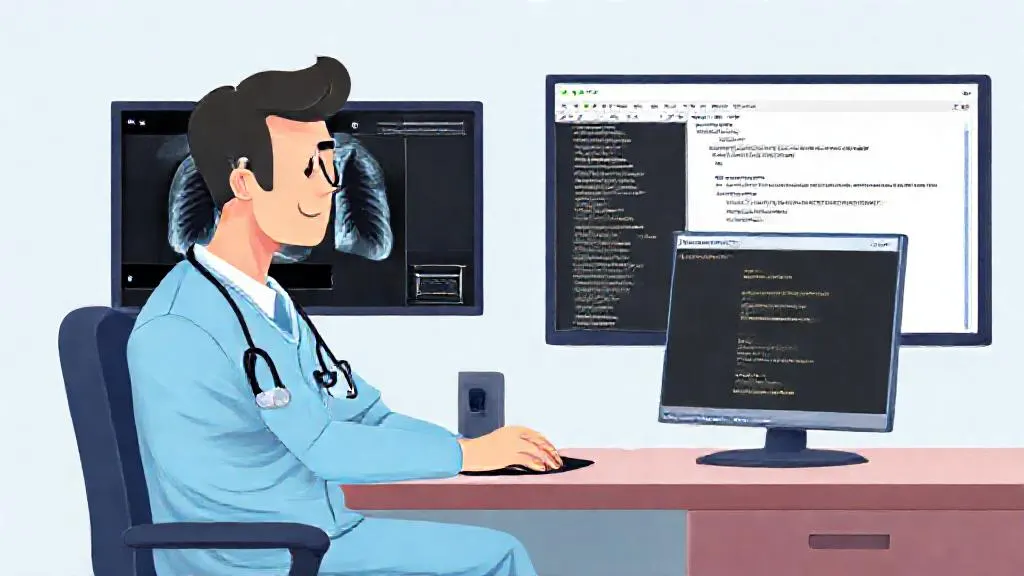
Clinical documentation and data extraction. Deep learning can pull structured data from discharge summaries, referral letters or clinic notes, turning free text into coded diagnoses, medications or follow-up actions. A course covering NLP, such as fast.ai or the DeepLearning.AI Specialization, builds the foundation for this.
Audit, quality improvement and research summaries. Classification and clustering techniques help group similar cases, spot patterns and prepare summaries for morbidity and mortality meetings. The University of Illinois course teaches these techniques on structured datasets.
Evaluating AI tools for your department. When a vendor pitches an AI triage or diagnostic tool, a working knowledge of deep learning helps you ask the right questions about training data, evaluation and failure modes. fast.ai and the Udacity Nanodegree both cover model deployment and evaluation.
Any AI output used in a clinical setting must be reviewed by a qualified professional. It cannot replace clinical judgement, professional standards or sign-off.
How to decide where to start
Pick the course that matches the task you want to improve first. Check the time commitment against your rota, since a one-week course and a 127-hour specialisation serve different seasons of a career. Decide whether you need a certificate for appraisal or portfolio. If your goal is specific and you want the learning built around it, start your own deep learning path for clinical work with Upskili. It costs free to approximately $20, depending on AI token/credit usage, and adapts as you learn.
Frequently asked questions
Do I need to know how to code to take a deep learning course?
Most courses here assume basic Python, but fast.ai and the Packt course are designed for beginners with some coding experience. You do not need to be a software engineer. A working knowledge of variables, loops and functions is enough to start.
Will deep learning replace radiologists or other doctors?
It will change some tasks, not replace the doctor. Models are getting better at flagging obvious findings on images and suggesting triage categories. A doctor is still needed for complex cases, clinical context, uncertainty, communication with patients and final sign-off. The skill that grows in value is knowing how to assess what a model can and cannot do.
Can I use patient data to practise during a course?
Only if it is fully de-identified and you have the approval your institution requires. Most doctors start with the public datasets a course provides, then later explore whether a local audit or quality-improvement project allows use of de-identified data under existing governance.
Which course gives a certificate I can use for my appraisal or portfolio?
The DeepLearning.AI Specialization, the Packt course and the University of Illinois course all award shareable certificates. The CFI specialization provides a blockchain digital certificate. Udacity awards a program certificate on completion of the Nanodegree.
I only have a few hours a week. Is there a course that fits?
The Packt course is designed to be completed in one week at ten hours. fast.ai consists of nine lessons of around 90 minutes each, which you can spread over several weeks. Both are self-paced and work well around a clinical rota.
Should I learn PyTorch or TensorFlow as a doctor?
For your purposes, either is fine. The concepts transfer. fast.ai and the Packt course use PyTorch, while the DeepLearning.AI Specialization uses TensorFlow. Pick the course that matches your goal first; the framework is secondary.
How do I know if a vendor's AI tool is worth piloting in my department?
A foundation in deep learning helps you ask better questions: what data the model was trained on, how it was evaluated, whether the population matches yours, and what the failure modes look like. Courses that cover model evaluation and deployment, like fast.ai and the Udacity Nanodegree, build this skill directly.
Turn this into a plan for you
Tell Upskili what you want to be able to do. It works out the skills involved, starts from what you already know, and teaches them in order, adjusting as you go.
Start with your goalSources
- Deep Learning - Computer Vision for Beginners Using PyTorch, Packt via Coursera
- Deep Learning Specialization, DeepLearning.AI via Coursera
- Deep Learning Nanodegree, Udacity
- Practical Deep Learning for Coders, fast.ai
- Machine Learning for Accounting with Python, University of Illinois Urbana-Champaign via Coursera
- AI for Finance Specialization, Corporate Finance Institute