7 Best Generative AI Courses for Students in 2026: Skills for Real Work Tasks
By Samuel G · · 10 min read
The best course for a working professional depends on where you are starting. If you want a broad understanding of generative AI with no coding and no cost, begin with DeepLearning.AI's beginner course or the free University of Maryland certificate. If you need to build and deploy AI systems in your work, the technical paths from Google Cloud or Udacity fit better. A personalised option like Upskili starts from your own work goal and builds a path around it.
Quick comparison
| Course | Provider | Best for | Level | Duration | Certificate | Cost |
|---|---|---|---|---|---|---|
| Generative AI for Everyone | DeepLearning.AI | Anyone new to generative AI | Beginner | 5h1m | Certificate with PRO | Check the provider's current pricing. |
| Personalised learning path | Upskili (publisher of this guide) | Professionals who want a path built around their own work goal | Not stated | Not stated | Not stated | Free to approximately $20, depending on AI token/credit usage |
| Free Online Certificate in Artificial Intelligence and Career Empowerment | Robert H. Smith School of Business, University of Maryland | Early to mid-career professionals exploring AI and career moves | Not stated | Not stated | Free certificate from the University of Maryland | Free |
| Explore the business value of generative AI solutions | Microsoft Learn | Business leaders identifying AI opportunities | Not stated | Self-paced online | Not stated | Check the provider's current pricing. |
| Applied Generative AI Engineering | Udacity | Developers building and deploying AI solutions | Intermediate | 56 hours | Program Certificates | Subscription · Monthly |
| Applied Generative AI and Agentic AI | Johns Hopkins University | Technology and data professionals wanting a university credential | Not stated | 16 Weeks Online | Certificate of Completion from Johns Hopkins University; 11 CEUs | Check the provider's current pricing. |
| Advanced: Generative AI for Developers | Google Cloud (Google Skills) | App Developers, Machine Learning Engineers and Data Scientists | Advanced | Not stated | Not stated | Check the provider's current pricing. |
How we chose these courses
We picked courses that match how a working professional actually uses generative AI: drafting, summarising, analysing and building. Each course was checked against five criteria:
- Relevance to daily professional tasks. The course teaches skills you can apply the next working day, not just theory.
- No unnecessary prerequisites. A beginner course should not assume coding knowledge. An advanced one should say plainly what you need first.
- Hands-on practice with real work. The best learning happens when you apply the tool to documents, data or code that resembles your own.
- Clear cost. You should know what you will pay before you enrol, not after a sales call.
- A recognised certificate where it matters. For some roles, a university or platform credential adds weight. For others, it does not.
The list runs from the most accessible starting point to the most specialised. Course details come from each provider's own page, checked on 4 October 2026. We did not take the courses ourselves.
The 7 best generative AI courses, one by one
1. Generative AI for Everyone (DeepLearning.AI)
Best for: Anyone who wants to understand generative AI without writing code.
This beginner course, taught by Andrew Ng, explains how generative AI works, what tools exist, and how the technology affects business and society. It is self-paced and takes about five hours. No prior AI knowledge is needed.
What you'll learn:
- How generative AI works under the hood
- Common tools and their real-world uses
- The impact of generative AI on business and society
Worth knowing: The certificate requires a PRO subscription. The course gives a conceptual grounding but does not include hands-on coding projects.
Cost and certificate: Check the provider's current pricing. Earn a certificate with PRO.
2. Upskili: a personalised path for your goal
Best for: Professionals who want learning built around their specific work goal, not a fixed syllabus.
Suppose your goal is to use generative AI to draft client proposals faster. You tell Upskili what you want to achieve, your current skill level and your background. It works out which skills you need and teaches them in order, measuring progress by what you can demonstrate. As your capability grows, the path adapts.
Upskili, the platform that publishes this guide, is not a pre-written course. It is a personalised, AI-powered learning option. Traditional courses are prepared in advance for a broad audience. Upskili starts from your own goal and builds the path around it. It is especially relevant if you have a clear work task in mind and want to skip material you do not need.
What you'll learn:
- The specific skills required to meet your stated work goal
- How to apply generative AI directly to your own tasks
- Capability measured by what you can do, not time spent
Worth knowing: This is not a fixed course with a set syllabus. The experience depends on the goal you set and how you engage with the path.
Cost and certificate: Free to approximately $20, depending on AI token/credit usage. Certificate: Not stated.
3. Free Online Certificate in Artificial Intelligence and Career Empowerment (Robert H. Smith School of Business, University of Maryland)
Best for: Early to mid-career professionals who want a free, business-focused overview of AI and its career implications.
This online certificate covers what artificial intelligence is, how it transforms different business functions, and practical career topics like job searching and consulting. It is designed for professionals who need to understand AI's role in business without a technical deep dive.
What you'll learn:
- An overview of artificial intelligence
- How AI is changing business functional areas
- Career empowerment topics such as job searching and consulting
Worth knowing: The course is broad rather than deep. It will not teach you to build or fine-tune models. The certificate is free, which is uncommon for a university-branded programme.
Cost and certificate: Free. Free certificate in "Artificial Intelligence and Career Empowerment" from the Robert H. Smith School of Business at the University of Maryland.
4. Explore the business value of generative AI solutions (Microsoft Learn)
Best for: Business leaders and managers who need to spot high-value AI opportunities and assess readiness.
This self-paced learning path from Microsoft focuses on identifying where generative AI can make a real difference in an organisation. It covers generative AI concepts, Microsoft Copilot, Azure AI and intelligent agents. The emphasis is on responsible implementation, not code.
What you'll learn:
- How to identify high-value generative AI opportunities
- How to assess organisational readiness for AI
- How to implement responsible AI solutions
- Generative AI concepts and Microsoft Copilot
Worth knowing: The content is tightly linked to Microsoft's own ecosystem. If your workplace uses other platforms, some tool-specific sections may be less directly applicable.
Cost and certificate: Check the provider's current pricing. Certificate: Not stated.
5. Applied Generative AI Engineering (Udacity)
Best for: Developers who want to build and deploy generative AI solutions.
This intermediate nanodegree programme covers the full pipeline: model selection, prompt engineering, parameter-efficient fine-tuning, retrieval-augmented generation systems, vector databases and multimodal applications. It is self-paced and runs about 56 hours.
What you'll learn:
- Building and deploying generative AI solutions
- Model selection and prompt engineering
- Parameter-efficient fine-tuning (PEFT)
- RAG systems and vector databases
- Multimodal applications
Worth knowing: It is aimed at developers, so you need programming experience. The subscription model means the total cost depends on how quickly you finish.
Cost and certificate: Subscription · Monthly. Program Certificates.
6. Applied Generative AI and Agentic AI (Johns Hopkins University)
Best for: Technology and data professionals who want a university credential with structured, hands-on projects.
This 16-week online certificate programme covers large language models, retrieval-augmented generation, prompt engineering, fine-tuning, agentic workflows and responsible AI. The learning is project-based and designed for professionals already working in technology or data roles.
What you'll learn:
- Large language models and how to work with them
- Retrieval-augmented generation (RAG)
- Prompt engineering and fine-tuning
- Agentic workflows
- Responsible AI practices
Worth knowing: At 16 weeks, this is the longest commitment on the list. It carries 11 CEUs and a university certificate, which may matter if your employer values accredited continuing education.
Cost and certificate: Check the provider's current pricing. Certificate of Completion from Johns Hopkins University; 11 CEUs.
7. Advanced: Generative AI for Developers (Google Cloud)
Best for: App Developers, Machine Learning Engineers and Data Scientists who want a technical, activity-based learning path.
This advanced path from Google Cloud includes 12 activities built for technical practitioners. The provider recommends completing the Introduction to Generative AI learning path first. It is hands-on and assumes you are comfortable in a development environment.
What you'll learn:
- Advanced generative AI techniques for developers
- Practical application through 12 structured activities
- Skills built for app development and machine learning workflows
Worth knowing: This is not a beginner course. You need the introductory path as a prerequisite, and the content assumes a working knowledge of AI development concepts.
Cost and certificate: Check the provider's current pricing. Certificate: Not stated.
Which course should you start with?
Match your situation to the right entry:
- You are new to generative AI and want the quickest start. Go with entry 1, Generative AI for Everyone. Five hours, no code, and a clear picture of what the technology can do.
- You want a free certificate from a known university. Entry 3, the University of Maryland's programme, gives you a business-focused overview at no cost.
- You manage a team or lead business decisions and need to spot AI opportunities. Entry 4, Microsoft Learn's path, is built for that exact role.
- You have a specific work goal and want a path built around it, not a generic syllabus. Entry 2, Upskili, starts from what you actually need to do.
- You are a developer who wants to build and deploy AI systems. Entry 5, Udacity's nanodegree, covers the full engineering pipeline.
- You want a university credential with structured projects and CEUs. Entry 6, the Johns Hopkins certificate, is the most substantial commitment.
- You are already an experienced AI practitioner and want advanced, activity-based training. Entry 7, Google Cloud's path, is the most specialised option.
A learning path for working professionals
You do not need to pick just one course. A sensible progression moves from foundations to practice to specialisation.
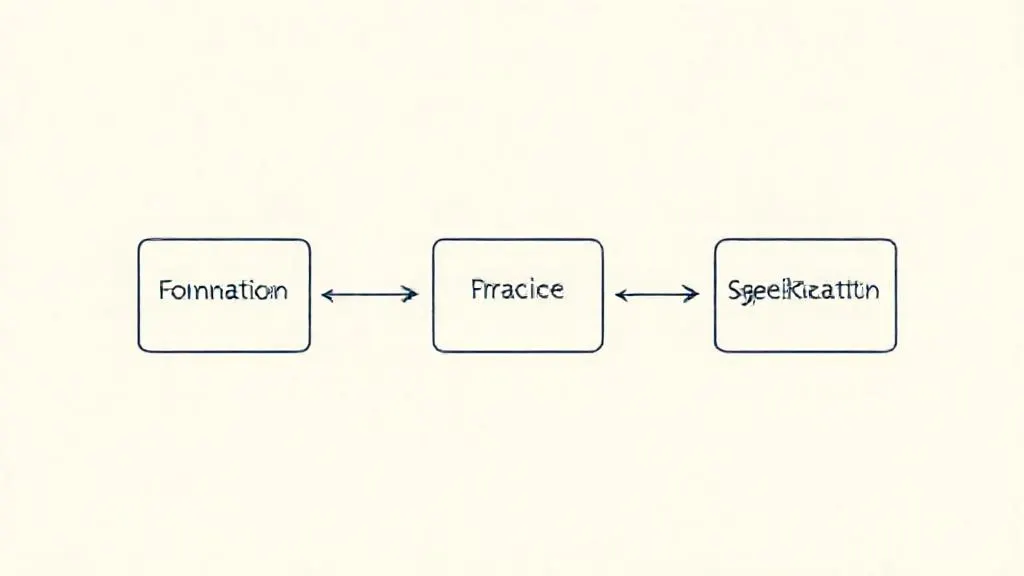
Phase 1: Foundations. Start with entry 1 (Generative AI for Everyone) if you want a quick, broad grounding. If you prefer a business lens and a free certificate, choose entry 3 (University of Maryland). If your focus is on identifying AI opportunities in your organisation, entry 4 (Microsoft Learn) works as a foundation too.
Phase 2: Hands-on practice with your own tasks. Once you understand the basics, apply what you learned to real work. Entry 2 (Upskili) is designed for this: you set a work goal and the path builds around it. Entry 4 also includes practical implementation guidance if you work in a Microsoft environment.
Phase 3: Specialisation. If your role demands building or deploying models, move to entry 5 (Udacity) for engineering skills, entry 6 (Johns Hopkins) for a university-backed deep dive, or entry 7 (Google Cloud) for advanced developer training.
Where generative AI fits in your work
Generative AI is not one skill for one task. It shows up across the work you already do.

Drafting and editing. Reports, emails, proposals and slide decks all start as drafts. A generative AI tool can produce a first version from a few bullet points. You then review, tighten and adjust the tone. For example, suppose you need to write a project update for a stakeholder. You give the tool your three key points and the audience. It drafts a structured update. You edit it for accuracy and your voice, then send it.
Summarising and research. Long documents, meeting transcripts and industry reports take time to digest. Generative AI can extract the main arguments and list action items. For example, you feed a 30-page market report into the tool and ask for a one-page summary organised by competitor. You verify the facts against the original before sharing the summary with your team.
Data analysis. Spreadsheets with hundreds of rows become easier to interrogate when you can ask questions in plain language. Generative AI can suggest formulas, spot trends and explain patterns. You still need to check the logic and ensure the conclusions hold.
Coding and automation. If you write formulas, scripts or queries, generative AI can speed up the work. You describe what you want the code to do, and it produces a starting point. You test, debug and adapt it. This applies whether you are writing a complex Excel formula, a Python script or a SQL query.
Where your work is regulated or carries legal or professional duties—accounting, law, engineering, medicine, finance and similar—AI output must be reviewed by a qualified professional. It does not replace professional judgement, standards or sign-off.
How to decide where to start
Pick the course that matches your current skill level and the time you have right now. If you are unsure, start with the shortest, most accessible option and see how the skill applies to your work. You can always go deeper later.
If you already have a clear work task you want to speed up—drafting, summarising, analysing or coding—a personalised path can cut out the material you do not need. Build a learning path around your own work goal and start from what you actually do every day.
Frequently asked questions
Do I need to know how to code to take a generative AI course?
Not for every course. 'Generative AI for Everyone' by DeepLearning.AI and the University of Maryland's free certificate require no coding. Courses aimed at developers, like Google Cloud's advanced path or Udacity's nanodegree, assume programming experience. Check the prerequisites before you enrol.
Will a generative AI certificate help me get a job?
A certificate shows structured learning but is rarely the deciding factor in hiring. Employers value what you can do with the skill more than the credential. The Johns Hopkins programme offers CEUs and a university certificate, which may carry weight in some organisations. Pair any course with examples of how you applied it to real work.
How long does it take to learn practical generative AI skills?
You can learn enough to speed up daily tasks like drafting emails or summarising documents in a few hours with a focused beginner course. Deeper technical skills, such as building retrieval-augmented generation systems, take weeks of hands-on practice. The courses here range from five hours to sixteen weeks.
Can I use generative AI tools on sensitive work documents?
Be careful. Many consumer AI tools use your input to improve their models, which can expose confidential data. Check your employer's policy and the tool's data usage terms before pasting sensitive material. Enterprise versions of these tools often have stronger privacy controls.
Is a free course good enough, or should I pay?
A free course like the University of Maryland's or Microsoft Learn can give you a solid foundation in concepts and business applications. Paid courses tend to offer more structured projects, instructor feedback or a recognised certificate. Start with a free option to gauge your interest, then invest if you need deeper hands-on practice.
Will AI replace my job?
Generative AI automates parts of tasks, not whole professions. It is good at drafting, summarising and pattern-matching but poor at judgement, accountability and understanding your specific context. The professionals who adapt fastest are those who learn to direct and review AI output, not ignore it. Your expertise in what good work looks like becomes more valuable, not less.
How do I practise generative AI skills on real work without risking mistakes?
Start with low-stakes tasks where you can easily verify the output. Summarise a public report you have already read, or ask the tool to draft an email you will rewrite anyway. Compare the AI's version with your own. As you learn its patterns and weaknesses, move to more complex work, always reviewing the final output yourself.
Are these courses recognised by employers?
Some carry more recognition than others. The Johns Hopkins certificate comes from an accredited university. Google Cloud and Microsoft Learn align with widely used platforms. Udacity's nanodegree is known in tech circles. No single course guarantees employer recognition, but choosing one tied to a known institution or platform helps.
Turn this into a plan for you
Tell Upskili what you want to be able to do. It works out the skills involved, starts from what you already know, and teaches them in order, adjusting as you go.
Start with your goalSources
- Advanced: Generative AI for Developers, Google Cloud
- Applied Generative AI and Agentic AI, Johns Hopkins University
- Free Online Certificate in Artificial Intelligence and Career Empowerment, Robert H. Smith School of Business, University of Maryland
- Generative AI for Everyone, DeepLearning.AI
- Applied Generative AI Engineering, Udacity
- Explore the business value of generative AI solutions, Microsoft Learn